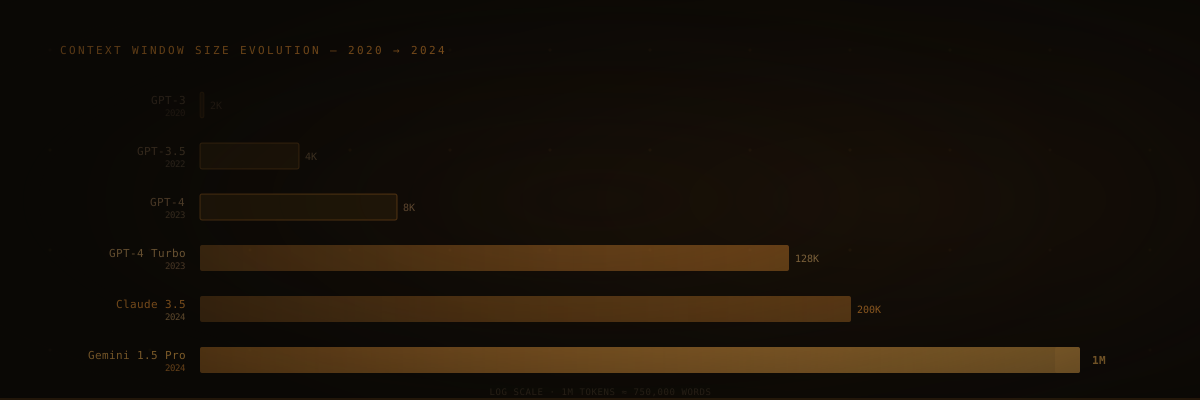
In early 2023, GPT-4 launched with a context window of 8,192 tokens — roughly 6,000 words, or about the length of a long magazine feature. Engineers celebrated. You could now have a genuinely sophisticated conversation with an AI model, ask it to analyze a document, or give it meaningful background context before a task.
By mid-2025, Gemini 1.5 Pro was running at 1 million tokens in production. Anthropic's Claude models had reached 200,000. The entire text of the Harry Potter series — all seven books — fits comfortably inside a single prompt.
This is not just a quantitative improvement. It is a qualitative shift in what AI systems can actually do — and it has become the most consequential, least publicly understood battleground in the entire AI industry.
What a Context Window Actually Is
The context window is the total amount of text — measured in tokens, where one token is roughly 0.75 words — that a language model can "see" and reason about in a single interaction. Everything inside the window is available to the model. Everything outside it doesn't exist.
Think of it as the model's working memory. A human reading a 1,000-page report can reference the introduction while analyzing the conclusion, hold a framework established 600 pages ago while evaluating new evidence, and integrate information from every section simultaneously. A language model with a small context window cannot. It can only see what fits in its window — which, for most of AI's commercial history, was the equivalent of a short chapter.
The token constraint defined the architecture of an entire generation of AI applications. Retrieval-Augmented Generation — RAG, the system where you break documents into chunks and retrieve relevant pieces before sending them to the model — exists entirely because context windows were small. Vector databases became a category worth billions of dollars because context windows were small. The entire "chunking and embedding" ecosystem — LangChain, LlamaIndex, Pinecone, Weaviate — was built to solve the same fundamental constraint: models couldn't read the whole document, so you had to figure out which parts to show them.
That constraint is dissolving. And the implications for the toolchain built around it are significant.
Why "More Context" Is Harder Than It Sounds
The naive assumption is that extending context windows is a straightforward engineering problem — more tokens, more memory, bigger window. It is not. The computational complexity of the attention mechanism at the core of transformer-based AI scales quadratically with sequence length.
This is the foundational challenge. Every token in the context window must "attend" to every other token — comparing its relationship to the full context. If you double the context window, you quadruple the compute required. At a million tokens, the naive implementation is computationally intractable.
The engineering solutions to this problem — Flash Attention, sparse attention, linear attention variants, sliding window mechanisms, and model-specific architectural innovations — represent some of the most important applied research in AI right now. They are not headline-grabbing like a new benchmark record, but they are the reason the benchmark records are possible.
The Hidden Problem: Models Forget the Middle
Here is the finding that every enterprise AI deployment should internalize immediately, and that most benchmarks are designed to obscure: more tokens in the context window does not mean all tokens are equally attended to.
The "Lost in the Middle" paper from Stanford (Liu et al.) demonstrated what engineers had been noticing in production for some time: language models systematically perform worse when the relevant information is in the middle of a long document, compared to when it's at the beginning or end. The attention mechanism preferentially focuses on recent tokens (recency bias) and prominent tokens at the start of context (primacy bias).
The practical implication is brutal: a model with a 100,000 token context window that is handed a 100,000 token document does not have uniform access to that document. Pages 1 and 300 are more reliably retrieved than pages 150. Conclusions and abstracts are more reliably referenced than methodology sections. And crucially, the model may not "know" that it missed something — it will synthesize an answer from what it does access with the same apparent confidence it would display if it had processed everything perfectly.
This doesn't mean long-context models aren't useful — they are enormously useful. It means the "needle in a haystack" evaluations that AI labs use to market long-context capability measure a specific, synthetic task (find this exact string in a large document), not the more complex, realistic tasks that production systems actually require. The marketing and the reality are adjacent, not identical.
Why This Battleground Matters More Than Benchmark Scores
The public conversation about AI models centers on benchmark performance: MMLU, HumanEval, MATH, GPQA, and a rotating cast of academic evaluations designed to measure reasoning capability. These benchmarks have real value. They also miss the variable that actually determines whether an AI system is useful in production: Can it hold enough context to do the job?
Consider what "jobs to be done" actually look like for enterprise AI:
A legal team needs a model to review a 400-page merger agreement and flag every clause that contradicts a set of 50 internal policies. That's 300,000 tokens of input minimum. A model without sufficient context either can't do it or does it badly by chunking — missing cross-document references, failing to track defined terms introduced on page 12 and used on page 380.
A financial analyst needs a model to synthesize five years of quarterly earnings transcripts for a company — approximately 200 transcripts at 5,000 words each — and identify every instance where management guidance materially diverged from subsequent results. That's a million tokens of input. The RAG approach will miss the subtle pattern shifts that span multiple quarters.
A software team needs a model to reason about a 500,000 line codebase, understand architectural dependencies between modules written two years apart, and suggest a refactoring approach that doesn't break existing contracts. No chunking system reproduces the full architectural context. Only a model that can hold the entire codebase in window can do this task reliably.
The Economics of Context: Why Price Matters As Much As Capability
Long context is not free. The computational cost of processing a million-token context window is substantially higher than processing a 4,000-token window — even with Flash Attention and other optimizations. The pricing tiers of frontier models reflect this reality.
This creates a crucial architectural decision that most organizations are not yet making systematically: when should you use long-context natively, and when should you still use RAG?
The answer is not "always use long context." It is a function of task type, token volume, frequency, and latency requirements. A customer support system handling 10,000 queries per day against a knowledge base of product documentation should probably still use RAG — the cost of native long-context processing at that volume would be prohibitive. A contract review system that processes 50 agreements per month but requires perfect recall across the entire document should probably use native long context, because the RAG-based alternative will make enough errors to require human review anyway, eliminating the efficiency gain.
The organizations building sustainable AI infrastructure are developing the analytical frameworks to make this decision correctly. The ones chasing the headline capability of the latest model are burning compute budget on use cases where a well-tuned RAG system would have been both cheaper and more reliable.
The Competitive Landscape: Who Is Winning and Why
The context window race has clear leaders, and the dynamics are more nuanced than the raw numbers suggest.
Google's Gemini 1.5 Pro holds the current production record at 1 million tokens (with research benchmarks at 2 million). Google's advantage here stems from architectural decisions made years ago — the Mixture of Experts approach and investment in custom TPU hardware gives them inference economics that no pure-software approach can currently match.
Anthropic's Claude has prioritized what they call "effective context use" — not just maximum tokens, but reliable recall and reasoning quality across the full window. Internal evaluations and third-party testing suggest Claude's attention quality at 100K tokens is more uniform than competitors at equivalent window sizes. This is the "Lost in the Middle" problem addressed architecturally, and it matters more in production than the headline token count.
OpenAI's GPT-4 Turbo brought 128K context to the mainstream — a meaningful step up from the original GPT-4's 8K — and remains the default enterprise choice due to ecosystem maturity, tooling, and organizational familiarity. The context quality is strong, though generally rated below Claude at equivalent window sizes by practitioners who have run comparative evaluations.
Open-source models — Llama, Mistral, and their derivatives — are closing the gap on context length, with some variants supporting 128K+ windows. The cost advantage of running open weights on owned infrastructure makes this particularly compelling for high-volume, cost-sensitive workloads where maximum context quality is less critical than unit economics.
What This Means for the RAG Ecosystem
The trillion-dollar question is whether the vector database and RAG ecosystem gets disrupted as context windows grow. The honest answer is: partially, over time, for some use cases.
The use cases where RAG will persist: real-time data retrieval (a model can't hold the live internet in its context window), extremely high-frequency queries at cost-sensitive scale, dynamic knowledge bases that update continuously, and hybrid architectures where certain retrieval tasks benefit from explicit embedding similarity search.
The use cases where RAG will erode: static document analysis, code review over stable codebases, legal and compliance review, any task where document completeness matters more than retrieval speed, and research synthesis across a fixed corpus.
The Next Horizon: Infinite Context and What Comes After
The logical endpoint of the context window arms race is a model that can process unlimited input — a perpetual context that persists across interactions, accumulating knowledge over time without bound. This is not science fiction. Multiple research directions are converging toward it.
External memory systems allow models to read from and write to structured external stores, extending effective context beyond what fits in a single forward pass. This is closer to how human memory actually works — fast working memory for current context, slower retrieval for long-term storage — and several production systems are already built this way.
State space models (SSMs) — architectures like Mamba — offer linear rather than quadratic scaling with sequence length, theoretically enabling very long contexts at costs that transformers cannot approach. They remain behind transformers on quality benchmarks for now, but the architecture is promising enough that several major labs have hybrid transformer-SSM research programs running.
Persistent agent memory — where AI agents maintain structured, queryable records of past interactions and learned facts — is the application layer that will matter most to end users. The model architecture is the plumbing. The memory system is what users will experience as the difference between an AI that "knows you" and one that starts cold every conversation.
The Bottom Line
Context window capacity has become the most practically important dimension of AI capability, and it receives a fraction of the coverage that benchmark leaderboards do. This is a gap in the public understanding of AI that has real consequences for the organizations and investors trying to navigate the space.
The framework to apply is simple: capability × context = actual utility. A model that scores 95 on a reasoning benchmark but loses track of information halfway through a 50,000-word document is less useful than a model that scores 85 but maintains reliable recall across the full document. For production AI workloads — which are defined by documents, codebases, transcripts, contracts, and records, not by synthetic benchmark tasks — context quality is often the deciding variable.
The organizations that will build durable AI advantages are the ones that move past "which model is smartest" to "which model can hold the context my actual workflow requires, at the quality level that prevents downstream errors, at the unit economics that make the workflow profitable." That is a more complex question than the benchmark leaderboards suggest. It is also a more answerable one — and answering it correctly is worth considerably more than picking the model with the highest MMLU score.
The context window arms race is not a technology story about memory limits. It is a business story about which AI systems can actually be trusted with the full complexity of real work. That story is just beginning.